
Ranks and the leaderboard
The pro ladder pages. The Stats lane's Rankings page with Pro, Vespene and SC2 Ladder tabs plus a player profile, and the Ranks page with account cards, map form, and every game a player has on record.
Two surfaces cover "who is good and what are they playing": the Rankings page on the Stats lane for browsing, and the Ranks page for the full player dossier. Both draw on the same player database, which is the interesting part, so that is where this article ends.
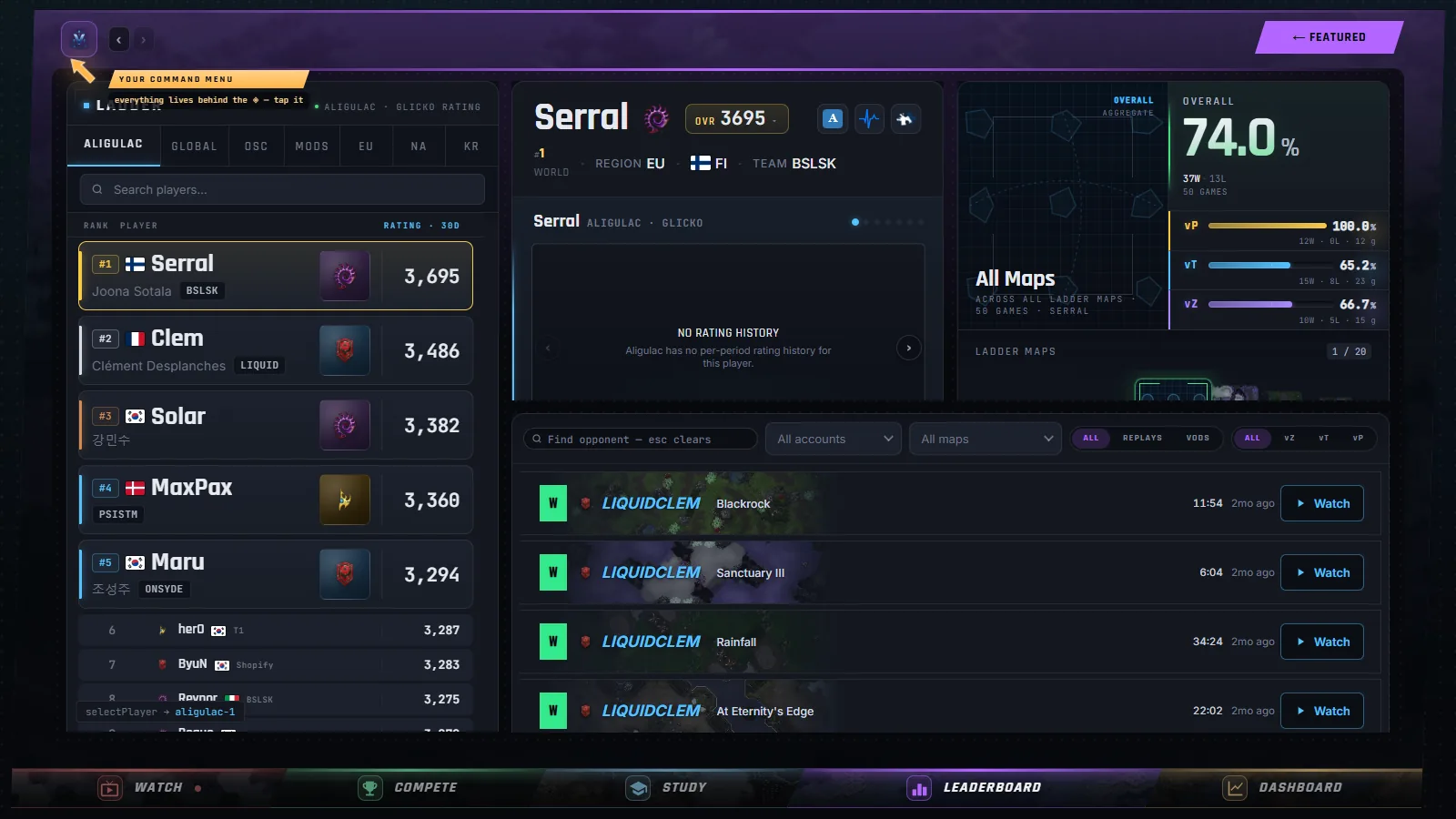
The Rankings page#
The Stats lane (it used to be called Leaderboard) has three pages: Rankings, Balance and Maps. Rankings splits into a list on the left and a persistent detail panel on the right. Your own numbers are not on this lane: they live on the Study lane's desk (The study desk).
Ladder tabs feed the list, in three groups: Pro (Aligulac for the pro rating, OSC for circuit standings), Vespene (Patches Mod, the Patch Clash ranked ladder, and Retail Ladder, everyone with a recent public ladder game on Vespene) and SC2 Ladder (Global, EU, NA and KR). A search box finds anyone in the database by name or alias.
Click a player and the detail panel fills in: identity, rating history graph, per-matchup form (vP, vT, vZ), and their profile: recent results, tournaments, openings, frequent opponents, tournament VODs and their match history.
The Ranks page#
The Ranks page (/#aligulac) is the four-card grid for deep study of one player at a time: the ladder list, the accounts card (every Battle.net account with per-account MMR), the map card (form per map), and the replay card: every game on record, paged, with server-side search. Click a game and it opens in the replay viewer.
The replay card pages instead of showing a fixed window, so a player's history cannot be buried by playing more games on top of it.
How player identity works here#
The database resolves people, not names:
- One real person is one master entry, holding however many Battle.net accounts they play on (main, smurfs, barcodes). Leaderboard rows aggregate per person; expand to see per-account stats.
- Identity keys on the Battle.net account first: platform IDs always outrank the display name, which is only a weakest-signal fallback when no ID is known. One account renamed twice is the same player.
- Barcode names (IIIlIIlI) are handled specially: a barcode string is never used to match identities, because it would sweep unrelated players together. Barcode accounts attach to a master through real identity signals instead.
This matters when you read profiles: "this player has 4 accounts, best MMR 6800" is the person's truth even when three of the accounts are anonymous barcodes.
Claiming your own profile#
If you play at a level where the harvester has seen your games, you likely already have a profile. Linking your Battle.net account (the Command Console's Settings tab) connects your uploads to your identity, and the Linked players list there surfaces database players found in your own replays so you can link the right profile as yours. From then on your uploads, your stats, and your public profile agree about who you are.
Verification is deliberately strict where it matters: surfaces that attribute a live match to a person trust an OAuth-verified Battle.net link, an organizer's roster assignment, or nothing. Typing a pro's battletag into your profile does not make you them anywhere it counts.